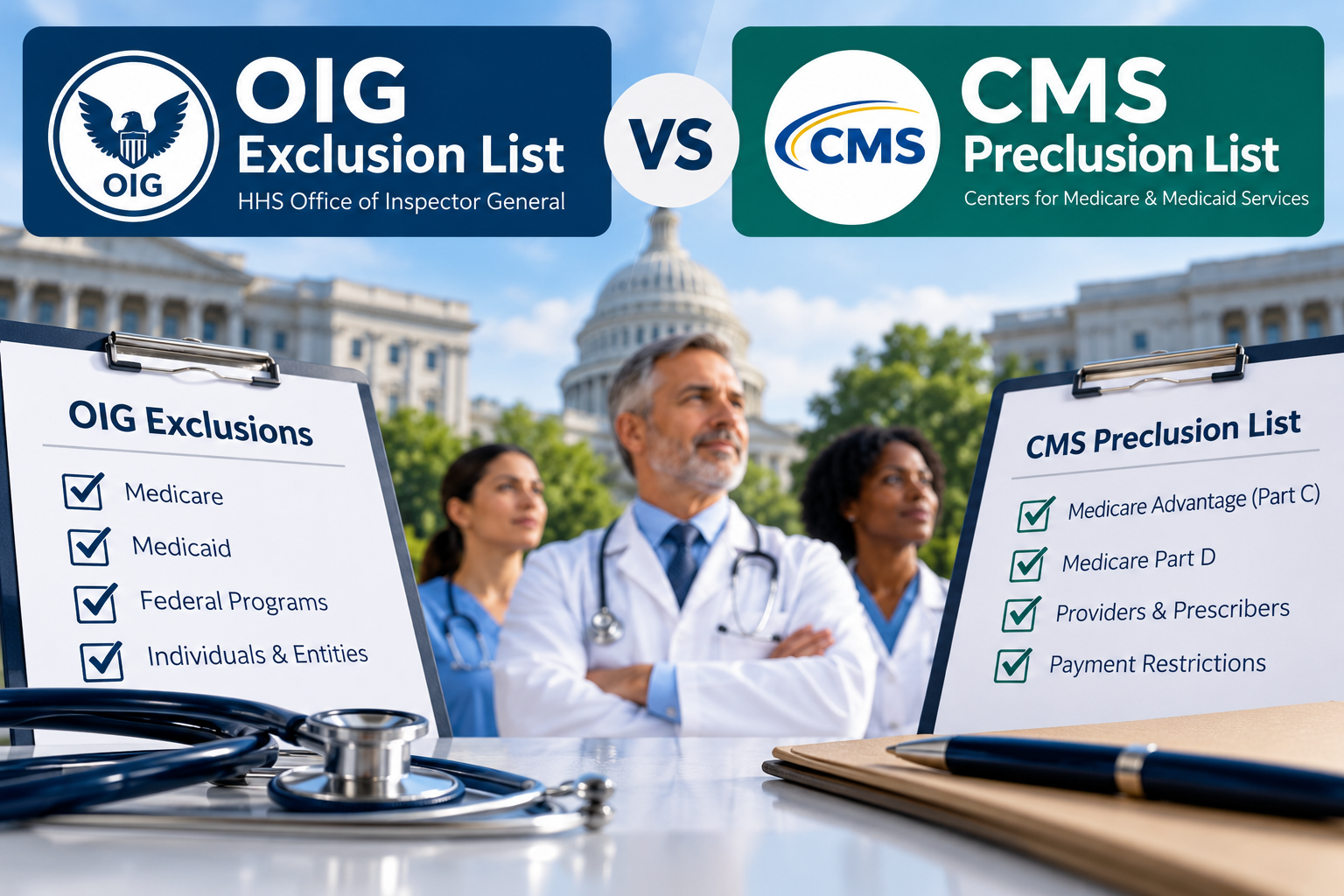
Medical practices must understand the differences between the OIG Exclusion List and the CMS Preclusion List. Both programs help protect federal healthcare programs from fraud, abuse, and improper payments. However, each program serves a different purpose and carries different consequences.
Understanding the OIG Exclusion List
The Department of Health and Human Services (HHS) Office of Inspector General (OIG) maintains the List of Excluded Individuals/Entities (LEIE).
The OIG uses this list to identify individuals and organizations excluded from participating in federal healthcare programs. These programs include Medicare, Medicaid, and other federally funded healthcare programs.
The list may include physicians, nurses, administrative employees, contractors, vendors, and healthcare organizations.
The OIG may exclude individuals or organizations for several reasons, including:
- Healthcare fraud and certain criminal convictions.
- Patient abuse or neglect.
- Certain professional licensing violations.
- Other violations that qualify for exclusion under federal law.
Federal healthcare programs generally cannot pay for services or items furnished by excluded individuals or entities.
Medical practices can search the OIG database to verify exclusion status. Practices should screen employees, providers, and relevant contractors before engagement and monthly thereafter.
Monthly screening helps practices identify exclusions and reduce financial and regulatory risks.
Understanding the CMS Preclusion List
The Centers for Medicare & Medicaid Services (CMS) maintains the CMS Preclusion List.
CMS uses this list to identify providers and prescribers who meet specific Medicare preclusion criteria.
The list primarily affects Medicare Advantage (Part C) and Medicare Part D prescription drug coverage.
CMS may place providers or prescribers on the list for several reasons, including:
- Revocation of Medicare enrollment under qualifying circumstances.
- Certain felony convictions.
- Conduct that meets CMS preclusion criteria.
Medicare Advantage plans generally cannot pay for healthcare items or services furnished by providers on the Preclusion List. Medicare Part D plans must also reject covered prescriptions from precluded prescribers, subject to applicable requirements.
Unlike the OIG database, CMS does not provide a publicly searchable Preclusion List.
Instead, CMS distributes the list to applicable Medicare Advantage and Part D organizations. These organizations must review the list and apply the required payment restrictions.
Why Medical Practices Must Understand Both Lists
The OIG Exclusion List affects participation and payments across multiple federal healthcare programs. The CMS Preclusion List focuses primarily on Medicare Advantage payments and Medicare Part D prescriptions.
An individual may appear on one list without appearing on the other.
Medical practices should establish screening procedures that address applicable federal and state requirements.
Regular screening helps practices identify potential compliance concerns before they create costly problems.
Protecting your practice requires more than checking employee credentials.
It also requires verifying eligibility to participate in federal healthcare programs.
By understanding both lists, medical practices can strengthen compliance efforts, reduce financial risks, and protect their organizations.
Does your organization have a process in place to manage your documentation?
Aris Medical Solutions can help you identify compliance gaps and prepare for upcoming changes.

Schedule your HIPAA compliance review today and protect your organization from the next enforcement headline.
Your Trusted Partner for HIPAA Compliance since 2009