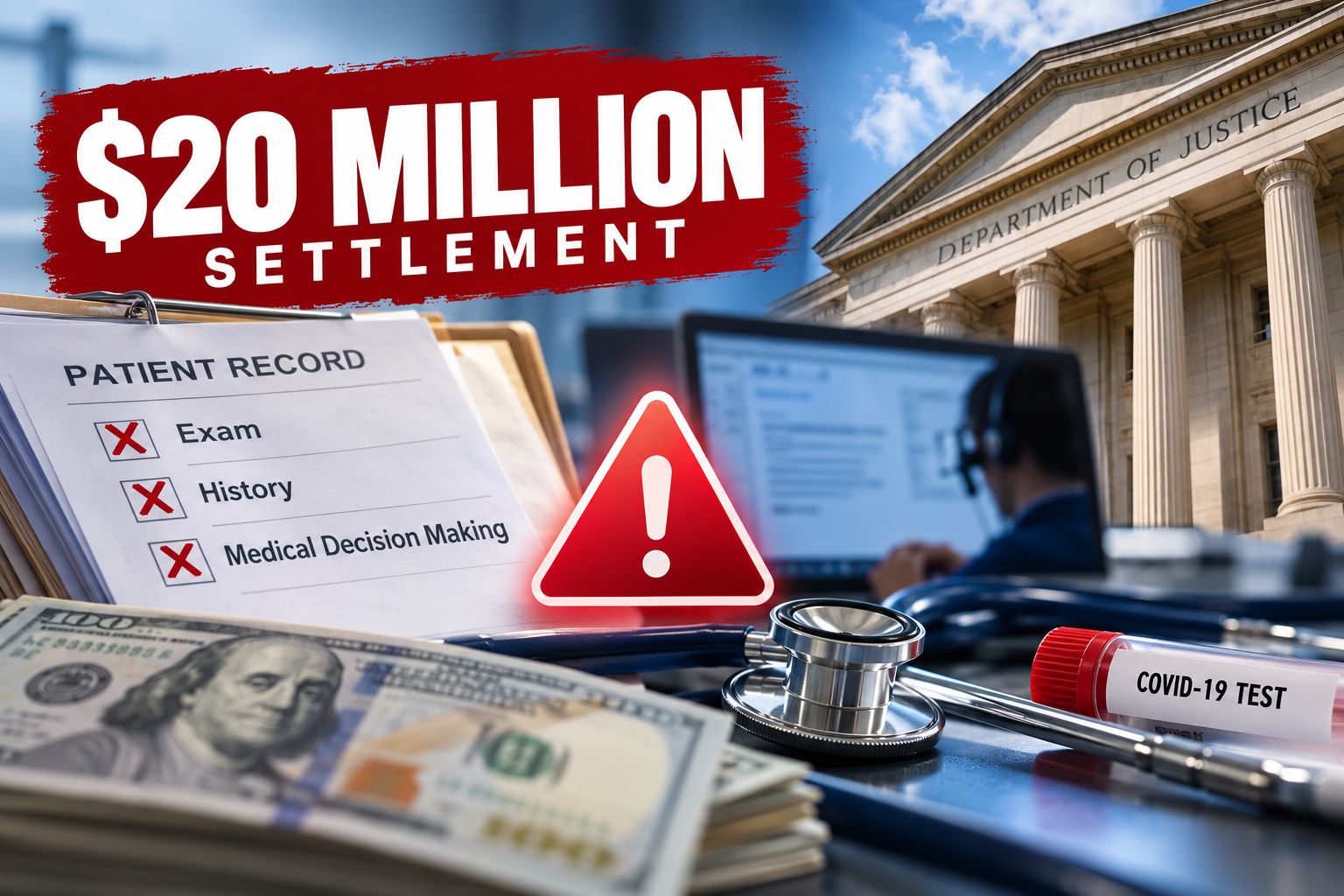
$20 Million Settlement Highlights Risks of False Medical Billing and AI-Generated Documentation
DOJ Settlement: $20 Million, Including $10 Million in Restitution
The U.S. Department of Justice (DOJ) announced a $20 million settlement involving Heal 360 urgent-care and primary-care clinics. The settlement resolves allegations that the clinics submitted fraudulent claims for COVID-19 testing services.
The DOJ alleged that Heal 360 billed a federal COVID-19 program for medical services the clinics never performed.
Patients reportedly received only COVID-19 specimen collection services. However, the clinics billed higher-level evaluation and management (E/M) codes, including 99203, 99204, 99213, and 99214.
These codes represented more extensive medical services than patients allegedly received.
How Medical Documentation Contributed to the Alleged Fraud
The DOJ identified several practices that raised serious concerns about billing accuracy and medical record integrity.
According to the allegations:
- False Medical Records: Staff used electronic templates to document examinations and medical services that never occurred.
- Remote Scribes: Overseas remote scribes entered information into patient records, including documentation supporting services the clinics allegedly never provided.
- Incorrect Rendering Providers: The clinics identified a physician as the rendering provider on most claims, despite no patient examination or treatment.
- Improper Billing: The clinics submitted hundreds of thousands of claims using higher-level E/M codes instead of appropriate collection codes.
These allegations highlight the importance of accurate medical documentation, proper coding, and provider oversight.
What This Means for Healthcare Providers
This settlement raises important concerns for medical practices, urgent-care centers, billing companies, coding vendors, and remote-scribe services.
Organizations using electronic templates or AI-assisted documentation should pay particular attention.
Technology can simplify medical documentation, but providers must verify that every record accurately reflects the services performed.
AI-generated notes and automated templates do not eliminate the provider’s responsibility for accurate documentation and billing.
Steps Healthcare Organizations Should Take Now
Healthcare organizations should review their documentation and billing procedures to reduce compliance risks.
- Verify Billing Accuracy: Compare billed E/M codes against the services performed and documented.
- Audit Medical Records: Review templated and copied notes for examinations, patient histories, or medical decisions that never occurred.
- Confirm Provider Responsibility: Require rendering providers to review and authenticate documentation supporting their claims.
- Review AI and Remote-Scribe Documentation: Verify the accuracy of AI-generated notes and information entered by remote scribes.
- Monitor Billing Vendors: Ensure billing companies select codes based on documented services, not automatically populated template fields.
- Address Overpayments: Investigate potential billing errors and promptly correct and return identified overpayments when required.
- Maintain Audit Trails: Preserve records identifying who created, reviewed, modified, and authenticated each medical note.
AI Documentation Creates New Compliance Responsibilities
Healthcare organizations increasingly rely on AI, remote scribes, and electronic templates to improve efficiency.
These technologies can reduce administrative workloads, but they also introduce documentation and compliance risks.
Providers must ensure that automated records accurately reflect each patient’s encounter.
A completed medical record does not prove that a documented service actually occurred.
Organizations should establish clear policies for reviewing AI-generated documentation, verifying clinical accuracy, and maintaining accountability.
The Bottom Line
This settlement does not prohibit healthcare organizations from using remote scribes, electronic templates, or AI-assisted documentation.
However, electronically generated records can become evidence in False Claims Act investigations when they misrepresent services.
Healthcare providers must maintain accurate records, verify billing codes, and ensure that documentation supports every submitted claim.
Remember: Technology can assist with documentation, but it cannot replace provider accountability.
The defendants deny the allegations, and the settlement does not establish liability.
Source: U.S. Department of Justice – Heal 360 $20 Million Settlement
Contact Aris Medical Solutions for a complimentary HIPAA compliance consultation.

Schedule your HIPAA compliance review today and protect your organization from the next enforcement headline.