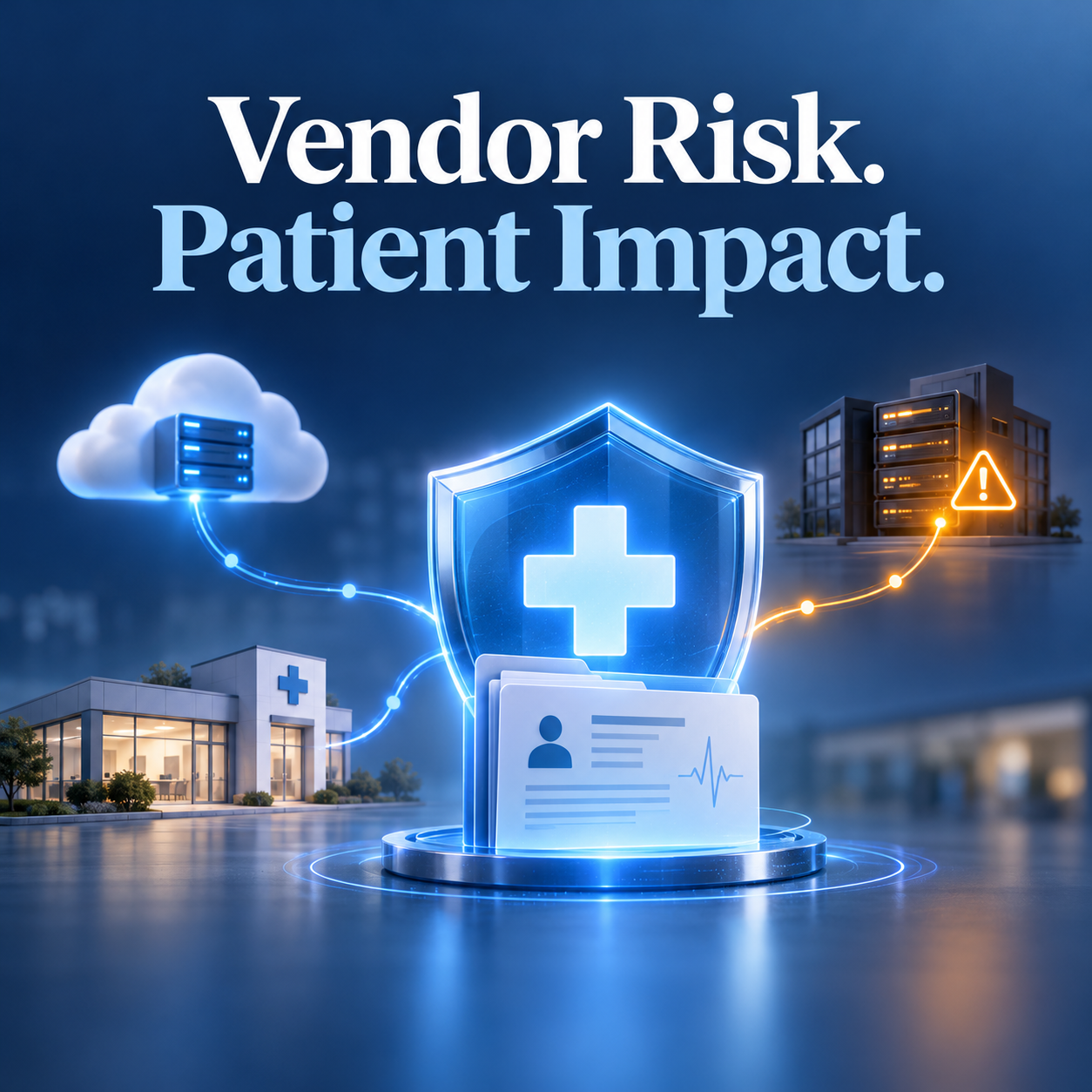
Vendor Risk Is the New Front Line
Healthcare organizations continue to report substantial data breaches in 2026. Hacking and IT incidents dominate reports to the HHS Office for Civil Rights (OCR). Large breach reports have eased slightly compared with 2025. However, third-party vendors and business associates continue to concentrate risk across healthcare.
The Healthcare Breach Landscape
During the first half of 2026, organizations reported 397 large healthcare breaches to OCR. These incidents affected approximately 33.8 million individuals. Although those figures declined from the previous year’s first half, they still represent substantial exposure.
Business associates played a role in approximately 43% of large breach reports. Hacking and IT incidents accounted for most cases. Several incidents illustrate how vendors, applications, and shared technology can expose patient information.
Notable 2026 examples illustrate the pattern:
DentaQuest
A May 2026 cyber incident affected approximately 15 million individuals connected to DentaQuest, a Sun Life subsidiary. The ShinyHunters extortion group claimed responsibility for the incident. The compromised information included names, addresses, Social Security numbers, and Medicare or Medicaid identifiers. It also included dental or vision information, such as diagnoses, treatment details, and billing records. DentaQuest began notifying individuals in July after the group reportedly leaked data following failed negotiations.
iRhythm Technologies
A June 2026 incident affected approximately 8.18 million people connected to iRhythm Technologies. Attackers used social engineering to access business applications hosted by third parties. The incident did not involve clinical systems or medical devices. The exposed information included names, contact details, birth dates, insurance numbers, account identifiers, serial numbers, and service dates. The company began notifications in October. At that time, it reported no evidence of identity theft.
Blueberry Pediatrics
An incident involving Blueberry Pediatrics affected approximately 341,000 individuals, including children. Attackers exploited a vulnerability in Metabase, a business intelligence and reporting tool. A related incident involving prescription partner Photon stemmed from the same vulnerability. The exposed information included names, birth dates, health plan details, and certain medical and billing information. Blueberry Pediatrics discovered the incident in August 2026 and began notifications in October.
Earlier Breaches Continue to Create Financial Consequences
Conduent’s 2024–2025 breach affected approximately 62.2 million individuals. The incident recently prompted an $80 million class-action settlement agreement.
Change Healthcare’s 2024 ransomware attack remains the largest reported healthcare breach, affecting approximately 192.7 million individuals.
These incidents show how one organization’s security failures can affect patients and healthcare partners nationwide.
OCR Continues to Prioritize Risk Analysis
OCR continues its Risk Analysis Initiative. Recent settlements repeatedly identify failures to conduct accurate and thorough risk analyses under the HIPAA Security Rule. The requirement appears at 45 CFR § 164.308(a)(1)(ii)(A). Several 2026 settlements highlight these recurring weaknesses.
Ambry Genetics
Ambry Genetics agreed to a $700,000 settlement following a phishing incident affecting approximately 225,000 people. OCR also identified concerns involving access termination and unique user identifiers.
OSF HealthCare System
OSF HealthCare System agreed to a $552,250 settlement involving a ransomware incident affecting approximately 54,000 individuals. OCR identified failures involving risk analysis, impermissible disclosures, and breach notification.
Spencer Gifts LLC
Spencer Gifts LLC agreed to a $450,000 settlement involving its employer-sponsored health plan after a ransomware attack. The case demonstrates that HIPAA obligations can extend beyond traditional healthcare providers.
Patient Access Still Drives Enforcement
OCR also continues its Right of Access Initiative. Shen Smiles, a Pennsylvania dental practice, agreed to a $140,000 settlement involving delayed patient access to records. OCR also identified related Privacy Rule deficiencies. The case reinforces a critical point: organizations can face HIPAA enforcement without experiencing a cyberattack.
What These Cases Mean for Healthcare Organizations
Vendor oversight requires ongoing attention.
Business associates, cloud applications, reporting tools, and billing partners create additional opportunities for unauthorized access. Identify which vendors create, receive, maintain, or transmit protected health information. Evaluate their safeguards and document your oversight. Address your organization’s HIPAA responsibilities when vendors handle patient information.
Risk analysis must reflect actual operations
An incomplete or outdated assessment can overlook significant threats. Include third-party applications, connected devices, remote access, and every location that stores or processes electronic protected health information. Evaluate phishing, social engineering, ransomware, and vendor vulnerabilities. Document identified risks, assign responsibility, and track corrective actions.
Contracts and notification procedures need clear ownership
Business associate agreements should clearly define incident reporting duties and applicable responsibilities. Organizations must also understand their own patient and OCR notification obligations. Practice your response before an incident forces urgent decisions.
Financial consequences extend beyond regulatory settlements
Breaches can trigger class action lawsuits, state investigations, operational disruptions, and substantial recovery expenses. Organizations may also pay for forensic investigations, notifications, monitoring, and system restoration. Patient trust can take much longer to rebuild.
Five Actions to Take Now
- Update your risk analysis. Include third-party systems, current threats, and changes in your operations.
- Review high-risk vendors. Request meaningful evidence of security controls and evaluate how those safeguards protect your information.
- Test your incident response procedures. Confirm reporting contacts, notification timelines, decision responsibilities, and procedures for vendor incidents.
- Strengthen patient access procedures. Train staff to recognize requests, track deadlines, document responses, and escalate delays.
- Review cyber insurance. Examine coverage limits, vendor-related incidents, exclusions, and policy conditions with your insurance professional.
Attackers exploit weaknesses throughout the healthcare ecosystem. OCR continues to evaluate organizations against core HIPAA requirements.
Organizations that treat risk analysis, vendor management, and incident response as continuous disciplines, not annual checkboxes, will be better positioned as these trends evolve.
This article is for informational purposes only and does not constitute legal advice. Organizations should consult qualified counsel regarding specific compliance obligations.
When was the last time your organization updated its HIPAA security risk analysis?
Aris Medical Solutions can help you identify compliance gaps and prevent costly data breaches.

Schedule your HIPAA compliance review today and protect your organization from the next enforcement headline.
Your Trusted Partner for HIPAA Compliance since 2009